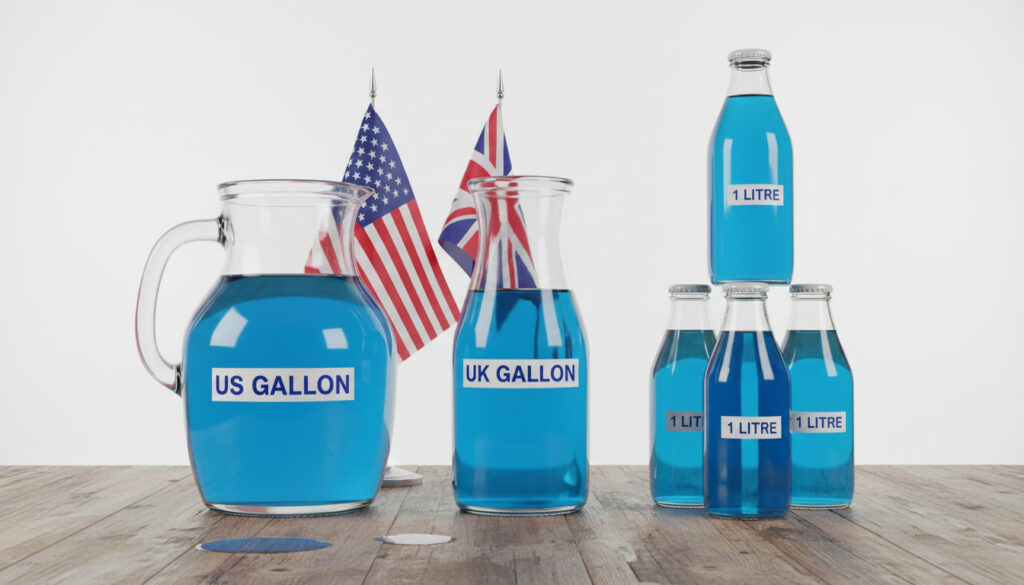
How Many Litres In A Gallon – US vs UK Conversions
The question carries a hidden precision: one US gallon equals exactly 3.785411784 liters, while the imperial gallon used in the United Kingdom measures exactly 4.54609 liters. This 20% volume gap creates significant discrepancies in fuel calculations, recipe conversions, and industrial measurements across borders.
Travellers frequently encounter this confusion at petrol stations. A vehicle rated for 30 miles per US gallon achieves different efficiency metrics when switched to imperial measurements. Similarly, a British recipe calling for a gallon of liquid requires substantially less volume than its American counterpart anticipates.
The divergence stems from separate standardization efforts in the 19th century. The United States cemented its definition based on the 1707 Winchester wine gallon, while Britain overhauled its system with the 1824 Weights and Measures Act, creating the imperial standard.
How Many Liters Are in a US Gallon?
The US liquid gallon holds precisely 3.785411784 liters. This value represents 231 cubic inches, standardized by the National Institute of Standards and Technology for all trade and scientific applications within the United States.
- Always specify US or Imperial to avoid calculation errors exceeding 20%
- The US gallon dominates measurement systems throughout the Americas
- One liter converts to approximately 0.264172 US gallons
- Imperial gallons persist in Canadian and British contexts from pre-metric eras
- Fuel economy ratings require careful attention to gallon type when comparing vehicles
- The US definition traces directly to 231 cubic inches established in 1836
- US gallons contain 128 fluid ounces versus 160 in the imperial system
| Volume | US Gallons (Liters) | Imperial Gallons (Liters) |
|---|---|---|
| 1 gallon | 3.785 | 4.546 |
| 2 gallons | 7.571 | 9.092 |
| 3 gallons | 11.356 | 13.638 |
| 5 gallons | 18.927 | 22.730 |
| 10 gallons | 37.854 | 45.460 |
| 1 liter (to gallons) | 0.264 | 0.220 |
| 20 liters (to gallons) | 5.283 | 4.399 |
How Many Liters Are in a UK (Imperial) Gallon?
The imperial gallon contains exactly 4.54609 liters. This measurement, established by the 1985 Weights and Measures Act, replaced earlier definitions tied to the weight of water at specific temperatures.
The Modern Metric Definition
Since 1985, British law has fixed the imperial gallon at precisely 4.54609 liters. This metrication effort aligned the traditional unit with international standards, though the UK officially switched to liters for most commercial trade during the 1970s and 1980s. The exact value facilitates precise scientific and industrial calculations without fractional discrepancies.
Historical Connection to Weight
Originally, the imperial gallon represented the volume occupied by ten pounds of distilled water at 62 degrees Fahrenheit (16.7 degrees Celsius). This definition, codified in 1824, equated to approximately 277.4194 cubic inches. The shift from a weight-based to a volume-based standard eliminated temperature-dependent variations that affected precise measurements.
The imperial gallon exceeds the US gallon by exactly 1.20095 times. When converting recipes or fuel calculations, failing to account for this 20% difference results in significant errors—particularly noticeable when scaling industrial chemical mixtures or baking measurements.
US vs. UK Gallon: Key Differences in Liters
The 20% volume differential creates distinct practical consequences across measurement contexts. While both systems divide gallons into four quarts and eight pints, the absolute volume of these sub-units differs substantially.
Sub-Unit Variations
A US gallon comprises 128 fluid ounces, whereas the imperial gallon contains 160 fluid ounces. Both systems maintain eight pints per gallon, yet an imperial pint equals 568.261 milliliters compared to the US pint at 473.176 milliliters. Similarly, quarts in the imperial system measure approximately 1.136 liters versus 0.946 liters in the US system.
The 20% Gap in Practice
One imperial gallon equals roughly 1.2 US gallons. Conversely, one US gallon equals approximately 0.8327 imperial gallons. This discrepancy means that five imperial gallons hold nearly the volume of six US gallons—a difference that compounds quickly in commercial shipping and fuel transport calculations.
Motorists crossing between the United States and Canada face particular confusion. Fuel economy ratings listed in miles per imperial gallon appear 20% more efficient than equivalent miles per US gallon ratings. A vehicle achieving 30 mpg (US) translates to approximately 36 mpg (imperial).
When selecting bedding for international shipping, understanding these measurement differences proves crucial for calculating space requirements. Super King Size Mattress Dimensions vary by region, requiring similar attention to unit distinctions.
How to Convert Gallons to Liters (Formula and Chart)
Accurate conversion requires identifying the gallon type before applying mathematical formulas. Online converters simplify this process, but manual calculations demand precise constants.
US Gallon Conversion
Multiply US gallons by 3.785411784 to obtain liters. For example, 5 US gallons convert to 18.92705892 liters. For rough estimations, multiplying by 3.785 provides sufficient accuracy for most household applications.
Imperial Gallon Conversion
Multiply imperial gallons by 4.54609 to determine liter volume. Five imperial gallons equal 22.73045 liters. This larger conversion factor reflects the imperial gallon’s greater capacity established during 19th-century British standardization.
Reverse Conversions
To convert liters to US gallons, multiply liters by 0.264172 or divide by 3.785411784. For imperial gallons, multiply liters by 0.219969 or divide by 4.54609. These reciprocal formulas allow bidirectional calculations between metric and customary systems.
Scientific applications require the full precision constants (3.785411784 and 4.54609). Everyday cooking and fuel calculations typically use rounded values to three decimal places without significant practical impact.
| Gallons | US (Liters) | UK (Liters) |
|---|---|---|
| 1 | 3.785 | 4.546 |
| 2 | 7.571 | 9.092 |
| 3 | 11.356 | 13.638 |
| 5 | 18.927 | 22.730 |
| 10 | 37.854 | 45.460 |
| 13 | 49.205 | 59.098 |
Common Comparisons: Liters vs. Gallons
Direct comparisons between liters and gallons frequently surface in cooking, automotive, and travel contexts. Understanding relative volumes prevents costly measurement mistakes.
Four liters approximate one US gallon (3.785 liters), falling short by roughly 215 milliliters. However, four liters significantly exceed one imperial gallon’s proportion, constituting only about 88% of the larger British measure. One liter equals approximately one-quarter US gallon (0.264) or just over one-fifth imperial gallon (0.22).
The gallon universally exceeds the liter in volume. One imperial gallon contains nearly four and a half liters, making it substantially larger than the standard metric unit. When Is Easter in 2026 calculations require no such unit conversions, unlike liquid measurements.
Why Are There Different Types of Gallons?
-
The Winchester wine gallon (231 cubic inches) becomes the standard liquid measure in England, later adopted by American colonies.
-
Parliament establishes the imperial gallon based on 10 pounds of water at 62°F, creating a distinct standard from the existing wine gallon.
-
The United States formally adopts the 231 cubic inch definition as the US standard gallon, preserving pre-1824 British measures.
-
The UK transitions the imperial gallon to exactly 4.54609 liters in preparation for full metrication.
-
The Weights and Measures Act mandates liters for trade in the UK, though imperial gallons persist in certain contexts.
-
The United States maintains customary gallons exclusively, while the UK officially uses liters, with imperial units surviving primarily in traditional recipes and older vehicle specifications.
What Is Exactly Established vs. What Varied?
Precisely Defined
- US liquid gallon: exactly 3.785411784 liters (NIST standard)
- Imperial gallon: exactly 4.54609 liters (UK legislation)
- Volume ratio: Imperial gallon equals 1.20095 US gallons
- Sub-unit counts: Both systems use 4 quarts, 8 pints per gallon
Context-Dependent
- “Gallon” without qualification defaults to local standard
- US dry gallon (4.404884 L) rare except for agricultural commodities
- Pre-1824 historical definitions varied by region and commodity
- Temperature fluctuations affect water-weight definitions historically
Where Do These Conversions Matter Most?
Fuel consumption represents the most visible application. The United States Environmental Protection Agency rates vehicle efficiency in miles per US gallon, while older British publications reference miles per imperial gallon. International travelers comparing these figures without conversion factor adjustments draw incorrect conclusions about vehicle economy.
Food and beverage industries handle similar complexities. US milk containers typically hold one US gallon (3.785 L), while historical British recipes referencing gallons require imperial conversions. The US Geological Survey estimates American daily domestic water use at 82 US gallons per capita—equivalent to 310 liters, not the 373 liters the same volume would represent in imperial measurements.
Industrial chemical mixing and international shipping rely on precise specification. Tank capacities and chemical concentrations must explicitly state gallon type to prevent dosage errors exceeding 20%. Tank specifications frequently clarify both standards to avoid loading miscalculations.
Sources and Standards
The US gallon is legally defined as 231 cubic inches, equivalent to exactly 3.785411784 liters, and has been the standard unit of liquid measure in the United States since 1836.
— National Institute of Standards and Technology, Handbook 44
The imperial gallon was redefined in 1985 as exactly 4.54609 litres, replacing earlier definitions based on the volume of 10 pounds of water at 62 degrees Fahrenheit.
— UK Weights and Measures Act 1985
The divergence between US and imperial gallons stems from the United States retaining the pre-1824 wine gallon definition while Britain adopted the imperial system.
Summary: Key Conversions to Remember
One US gallon equals 3.78541 liters, while one imperial gallon equals 4.54609 liters—a 20% difference originating from divergent 19th-century standardization efforts. Always verify which gallon standard applies before calculating fuel economy, recipe volumes, or chemical mixtures. The United States maintains the 231 cubic inch definition, whereas the UK officially uses liters commercially though imperial gallons persist in specific traditional contexts. Super King Size Mattress Dimensions demonstrate similar regional measurement variations.
Frequently Asked Questions
How many gallons in 1 liter?
One liter equals approximately 0.264 US gallons or 0.220 imperial gallons. Divide liters by 3.785 for US gallons or by 4.546 for imperial gallons.
Is 4 liters equal to 1 gallon?
Four liters roughly equals one US gallon (3.785 L), but exceeds one imperial gallon significantly. Four liters is approximately 1.06 US gallons or 0.88 imperial gallons.
How many liters in 5 gallons?
Five US gallons equal 18.927 liters. Five imperial gallons equal 22.730 liters. The difference exceeds 3.8 liters between the two standards.
Why is the UK gallon bigger?
The UK imperial gallon derives from the volume of ten pounds of water, while the US gallon originated from the 1707 Winchester wine gallon of 231 cubic inches. Britain reformed its measures in 1824; the US retained colonial-era definitions.
Can I use US gallons in UK recipes?
Using US gallons in recipes specifying imperial gallons results in a 20% shortfall. Multiply US gallons by 1.201 to obtain equivalent imperial volumes, or convert to liters first for accuracy.
What is a dry gallon?
The US dry gallon equals 4.404884 liters, used primarily for agricultural commodities like berries and grains. It differs from both liquid US gallons and imperial gallons, though it remains rare in modern commerce.
How many liters in 10 gallons?
Ten US gallons equal 37.854 liters. Ten imperial gallons equal 45.460 liters. Always verify the gallon standard when interpreting specifications to avoid 7.6-liter discrepancies.
More related posts
 When Is Pancake Day 2026 – Dates, History and Traditions
 Equestrian Property for Sale – UK Listings Prices and Regions
 Andrew Sachs – Biography, Death, and Fawlty Towers
 Tijjani Reijnders – Biography, Stats & Man City Transfer
 Bargain Hunt Presenters – Current & Former Cast (2025)
 What Does DBI Mean – TikTok Slang, Texting and Antenna Guide
 How to Screenshot on Chromebook – Full Guide for All Devices
 Tony Sirico – Cause of Death, Criminal Past and Sopranos Legacy
