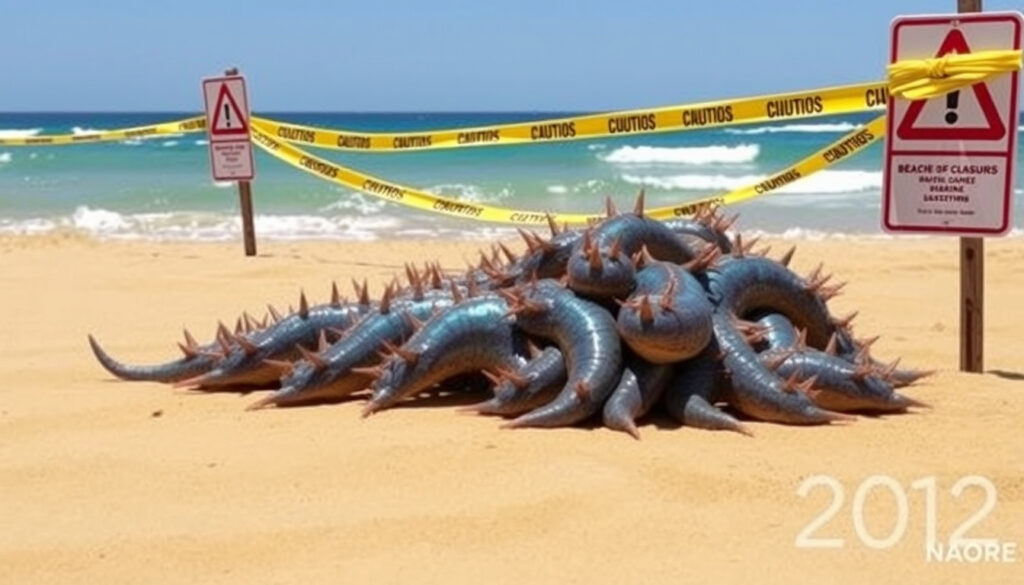
Venomous Blue Dragons Alicante – Beach Closures and Safety Guide
Spanish coastal authorities closed multiple beaches in August 2025 after sightings of Glaucus atlanticus, commonly known as blue dragons. The small but venomous sea slugs triggered health warnings across several regions, including Guardamar del Segura in Alicante.
The creatures, measuring approximately 3-4 centimeters in length, possess a powerful venom they acquire from consuming other venomous species. While their sting rarely causes severe symptoms in humans, local officials raised red flags to protect beachgoers from potential harm.
The appearance of blue dragons along Mediterranean shores marked an unusual event for a region where such sightings remain relatively uncommon. Coastal municipalities implemented swimming prohibitions while scientists monitored the situation closely.
What are blue dragons spotted on Spain beaches?
Blue dragons are small marine gastropods belonging to the Glaucidae family. Despite their diminutive size, these creatures carry a venom far more potent than their appearance suggests. Their striking blue coloration serves as a warning to potential predators about their toxic nature.
Glaucus atlanticus sea slugs
Guardamar del Segura, Alicante coast
August 20-25, 2025
Beaches closed to swimming
- Blue dragons feed primarily on Portuguese man o’ war and other venomous cnidarians
- They concentrate and store the consumed venom in their own tissues for defense
- Despite their venom, human stings typically cause only mild symptoms including skin irritation or allergic reactions
- The species is fairly uncommon in the Mediterranean Sea
- Ocean currents and wind patterns typically transport them to coastal areas
- They are found in temperate and tropical waters across Atlantic, Pacific, and Indian Oceans
| Attribute | Details |
|---|---|
| Scientific Name | Glaucus atlanticus |
| Size | 3-4 centimeters |
| Habitat | Open ocean; rarely seen near shores |
| Venom Source | Concentrated from prey species |
| Primary Human Risk | Pain, nausea, potential allergic reactions |
| Recent Location | Alicante, Valencia, Cádiz, Canary Islands |
Why were Alicante beaches closed due to blue dragons?
On August 20, 2025, two blue dragon specimens were discovered on Playa Vivers in Guardamar del Segura. Local authorities responded by raising red flags and prohibiting swimming across all eleven kilometers of the municipality’s coastline. Beach access remained technically open, but authorities used public address announcements to inform visitors about the swimming ban.
The mayor urged the public to report sightings and avoid direct contact with the creatures, even while wearing gloves. The municipality deployed monitoring operations to detect additional specimens along the affected shoreline.
Authorities implemented a multi-layered approach: red flag systems to prohibit swimming, active monitoring operations, public reporting requests, and informational announcements. Officials characterized the situation as “a very isolated episode that has ended up as just a holiday anecdote.”
Official safety measures implemented
The coordinated response included several key elements designed to protect public safety while maintaining transparency. Beach lifeguards received briefings on identifying the creatures and alerting visitors. Local marine rescue teams increased patrol frequencies along the coastline.
Scientists advised that the creatures posed minimal threat when left undisturbed. The primary concern centered on accidental contact by swimmers or beach visitors who might handle them without understanding their venomous nature.
Why authorities took preemptive action
The decision to close beaches reflected a precautionary approach given the unpredictability of individual allergic reactions. While most stings cause only mild discomfort, authorities could not rule out the possibility of severe responses in susceptible individuals.
The appearance of multiple specimens within a short timeframe justified the elevated response level. Officials prioritized visitor safety over the relatively low statistical probability of harmful encounters.
How dangerous are blue dragons to humans?
The risk posed by blue dragons to human health remains a subject of careful distinction between the creatures’ venomous capability and their actual impact on people. The sea slugs possess venom capable of paralyzing prey much larger than themselves, yet their effect on humans differs considerably.
Stings from blue dragons generally cause mild symptoms that include skin irritation and burning sensations. These reactions are not comparable to injuries caused by Portuguese man o’ war, the species from which blue dragons derive their concentrated venom.
Reported symptoms and health effects
Documented symptoms from blue dragon stings include intense pain, nausea, vomiting, and potential allergic reactions. Medical professionals advise rinsing affected areas with saltwater and seeking medical attention if symptoms persist or worsen.
The primary health concern centers on individual sensitivity rather than the venom itself. While most people experience discomfort that resolves within hours, others may develop more pronounced reactions requiring medical intervention.
Understanding the unpredictability factor
Researchers emphasize that the unpredictability of allergic responses represents the greatest health risk. There remains the possibility of severe reactions in individual cases, though such outcomes appear uncommon based on available evidence.
If you experience a blue dragon sting, rinse the affected area with seawater, avoid rubbing the site, and seek medical attention if pain intensifies or spreads. Do not apply fresh water, as this may worsen the reaction.
Where have blue dragons been sighted recently?
The August 2025 sightings extended beyond Guardamar del Segura to multiple coastal locations across Spain. The distribution of documented appearances suggests a broader phenomenon affecting several regions simultaneously.
Timeline of coastal appearances
On August 17, 2025, half a dozen specimens caused beach closures at Santa Bárbara beach in La Línea de la Concepción, Cádiz. This incident preceded the Alicante discoveries by several days, indicating the creatures were appearing along southern Spanish coasts during the same period.
Additional specimens were found at Canet de Berenguer beach in Valencia and beaches in Lanzarote’s Canary Islands throughout August. Scientists also documented a specimen in deep waters off Mallorca in the Tramuntana mountains, marking the first scientific record in the Balearic Islands since 1916.
Geographic distribution patterns
Blue dragons typically inhabit open ocean waters far from coastlines. Their appearance on beaches results from wind and current patterns that transport them shoreward. The species remains fairly uncommon in the Mediterranean, making the 2025 cluster of sightings particularly noteworthy.
Researchers believe multiple factors likely contributed to the unusual concentration of sightings, though the precise mechanisms remain subjects of ongoing investigation.
What caused the spike in blue dragon sightings?
The arrival of blue dragon specimens in Mediterranean coastal waters has been linked to rising sea temperatures. Mediterranean waters exceeded 28°C (82°F) at the end of June 2025, with thermal anomalies reaching up to five degrees above normal seasonal averages. For a comprehensive overview of the Year of the Dragon, consult our Blue dragons Alicante safety guide.
Warmer ocean conditions may alter the distribution of prey species and affect the currents that transport blue dragons toward coastlines. The timing of the sightings, concentrated in late summer, coincides with peak water temperatures in the region.
Scientists caution that insufficient evidence exists to definitively confirm a direct link between water temperature increases and blue dragon beach strandings. Studies on the species’ ecology and optimal environmental conditions remain limited.
Temperature data and environmental conditions
Temperature records from June and July 2025 indicate sustained warmth across Mediterranean coastal zones. The five-degree thermal anomaly observed represents a significant deviation from historical averages for the period.
Oceanographers note that anomalous warmth can affect marine species distribution throughout the food web. The presence of blue dragons may reflect broader changes in ecosystem dynamics driven by temperature shifts.
Current understanding and research needs
Researchers emphasize that the relationship between warming waters and blue dragon appearances requires further investigation. Limited scientific data exists regarding the species’ preferred environmental conditions and response to temperature fluctuations.
The scientific community has called for enhanced documentation efforts to improve understanding of blue dragon ecology in Mediterranean waters. Public participation in reporting sightings remains crucial for building comprehensive knowledge about the species’ movements.
Timeline of August 2025 beach closures
The sequence of blue dragon sightings and corresponding official responses developed rapidly during August 2025. Understanding the progression of events helps contextualize the official response and ongoing monitoring efforts.
- : Half a dozen blue dragon specimens identified at Santa Bárbara beach in La Línea de la Concepción, Cádiz, triggering beach closures
- : Two specimens discovered on Playa Vivers in Guardamar del Segura, prompting red flag warnings
- : Swimming prohibited across eleven kilometers of Guardamar coastline; monitoring operations intensified
- : Additional specimens reported at Canet de Berenguer beach in Valencia and Lanzarote beaches; scientists document first Balearic Islands record since 1916
The timeline demonstrates rapid escalation from initial sightings to coordinated beach management responses across multiple jurisdictions within a single week.
What is confirmed versus uncertain about blue dragons in Spain?
Distinguishing between established facts and unresolved questions provides clarity about the current scientific understanding of this phenomenon. Researchers have documented certain aspects while acknowledging gaps in knowledge.
Confirmed Information
- Multiple specimens appeared on Spanish beaches in August 2025
- Beaches implemented swimming prohibitions in response to sightings
- Blue dragons carry concentrated venom from consumed prey
- Human stings typically produce mild symptoms
- The species occurs rarely in Mediterranean waters
- Monitoring operations tracked specimen locations
Information Requiring Further Study
- Direct link between water temperatures and blue dragon strandings
- Population dynamics and future sighting probability
- Optimal environmental conditions for the species
- Long-term ecological implications for Mediterranean waters
- Precise factors triggering beach strandings
- Geographic extent of the phenomenon along other coastlines
What does this mean for Mediterranean coastal regions?
The appearance of blue dragons along Spanish coasts reflects broader changes occurring in Mediterranean marine ecosystems. Warmer waters and shifting ocean currents may influence the frequency of such sightings in coming years.
Coastal authorities have gained valuable experience in responding to unexpected marine species appearances. The protocols developed during the 2025 incidents may inform future management decisions if similar events occur.
Public awareness about marine species and beach safety has increased as a result of the media coverage surrounding these sightings. Visitors to Mediterranean beaches now have greater familiarity with the creatures and their potential risks.
How can the public help scientific documentation?
Scientists emphasize the importance of public participation in documenting blue dragon sightings. When specimens are encountered, photographs submitted to research institutions help maintain accurate records of species distribution and behavior.
“Photographs should be submitted to scientists to maintain accurate records of the species’ distribution and behavior. This data collection is critical given the limited scientific understanding of the species’ ecology in Mediterranean waters.”
Marine research community
Community involvement in scientific monitoring strengthens the overall knowledge base about marine species movements. Every reported sighting contributes to a clearer picture of blue dragon patterns in the region.
Summary: Understanding the blue dragon beach incident
The August 2025 appearance of blue dragons along Spanish coasts triggered coordinated responses from local authorities across multiple regions. Despite their small size, the creatures prompted beach closures and swimming prohibitions due to their concentrated venom and the unpredictable nature of human allergic reactions.
While documented symptoms in humans remain generally mild, officials adopted precautionary measures to protect beach visitors. The phenomenon has been linked tentatively to elevated Mediterranean water temperatures, though researchers acknowledge insufficient evidence to establish a definitive causal relationship.
Frequently asked questions about blue dragons
What is a blue dragon sea slug?
A blue dragon (Glaucus atlanticus) is a small sea slug measuring 3-4 centimeters with a potent venom concentrated from prey species. They possess striking blue coloration that warns predators of their toxicity.
Can blue dragons kill humans?
Blue dragons rarely cause severe harm to humans. Their stings typically produce mild symptoms including skin irritation and burning. Severe reactions remain possible but uncommon.
Where do blue dragons live?
Blue dragons inhabit temperate and tropical waters across the Atlantic, Pacific, and Indian Oceans. They are uncommon in the Mediterranean and normally live in open ocean waters.
Why do blue dragons appear on beaches?
Ocean currents and wind patterns transport blue dragons toward coastlines. Their appearance on Mediterranean beaches in 2025 coincided with elevated water temperatures, though the precise relationship remains under study.
What should I do if I find a blue dragon?
Do not handle blue dragons directly. Report sightings to local authorities and, if possible, submit photographs to scientific institutions for documentation purposes.
Are blue dragon sightings increasing?
The August 2025 appearances represented an unusual concentration of sightings in the Mediterranean region. Scientific monitoring continues to assess whether such events will become more frequent.
More related posts
 Tony Sirico – Cause of Death, Criminal Past and Sopranos Legacy
 Peter Capaldi – Complete Profile, Doctor Who, Oscar & Music
 Chris Pratt – Biography, Movies, Net Worth, Wife and More
 Manchester United vs Burnley Standings – 2025/26 Positions & Results
 James Blake – Biography, Music, Tour and Jameela Jamil
 Peter Jones – Dragons’ Den Star, Net Worth & Store Guide
 Zhao Xintong – Age, Height and Historic 2025 World Champion Profile
 Jeff Lynne Elo – Farewell Tour Ended, No 2026 Dates
