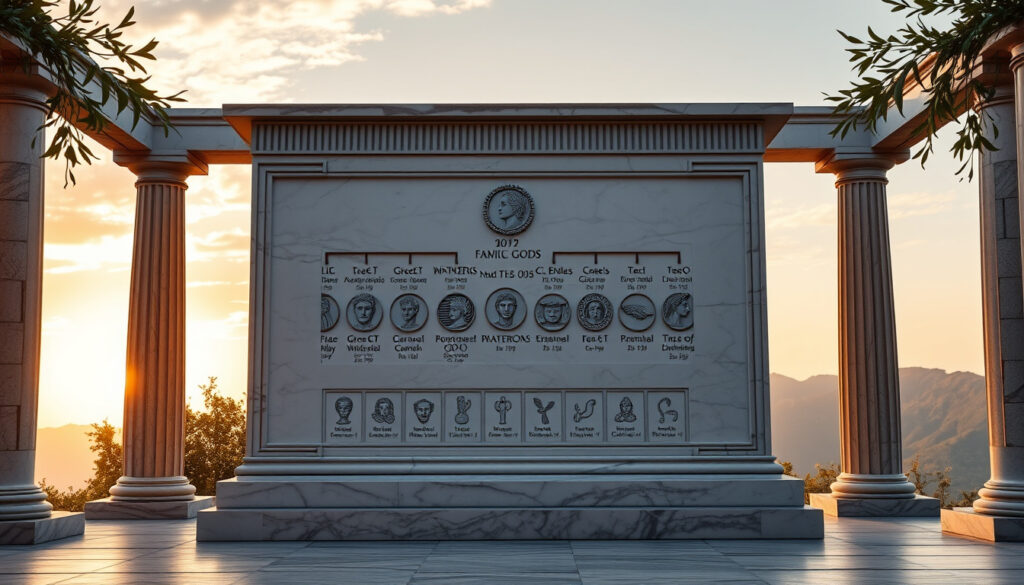
Greek Gods – Names, Family Tree, Powers And Roman Equivalents
The Greek gods form one of the most extensively recorded pantheons in world mythology. Their stories, relationships, and domains survive in ancient texts such as Hesiod’s Theogony and Homer’s epic poems, offering a detailed picture of a divine family that ranges from primordial forces to the Olympians of Mount Olympus.
The pantheon is layered and hierarchical. At the top stand the 12 Olympians, led by Zeus, with numerous minor gods, Titans, heroes, and personifications filling the ranks below. Roman religion later absorbed and renamed many of these deities, preserving much of their function while adjusting names and attributes.
Understanding the Greek gods means learning a network of names, powers, symbols, and family ties that has influenced Western literature, art, and language for centuries.
Who Are the Greek Gods and Goddesses?
Key Insights About the Greek Pantheon
- The Greek pantheon is hierarchical: Primordial deities (Chaos, Gaia) → Titans (Cronus, Rhea) → Olympians (Zeus, Hera, etc.).
- The 12 Olympians are the most well-known, but ancient Greek religion recognized hundreds of minor gods, heroes, and personifications.
- Zeus is the king of gods, yet many deities had greater cult followings in specific city-states — for example, Athena in Athens.
- Greek mythology heavily influenced Roman mythology, with many gods directly adopted under new names (Zeus became Jupiter, Hera became Juno).
- The family tree includes marriages and affairs among close relatives, reflecting ancient Greek social structures and storytelling traditions.
- Key source texts include Hesiod’s Theogony, Homer’s Iliad and Odyssey, and Ovid’s Metamorphoses (a Roman retelling).
Quick Facts About the Greek Gods
| Attribute | Details |
|---|---|
| Number of Major Olympians | 12 (or 14 depending on inclusion of Hades and Hestia) |
| Chief God | Zeus (Jupiter in Roman tradition) |
| Earliest Deities | Chaos, Gaia, Tartarus, Eros (Primordial) |
| Titan Leader | Cronus (Saturn) |
| Sacred Mountain | Mount Olympus |
| Key Source Texts | Hesiod’s Theogony, Homer’s Iliad & Odyssey, Ovid’s Metamorphoses |
| Domains Covered | War, love, wisdom, sea, underworld, sun, harvest, and more |
What Is the Greek Gods Family Tree?
The family relationships among Greek gods follow a clear generational structure. According to sources including the British Museum and the Theoi.com – Greek Gods & Goddesses database, the lineage begins with primordial entities and proceeds through the Titans to the Olympians.
Different ancient sources sometimes present conflicting genealogies. Hesiod, Homer, and later writers each emphasized different versions of the same myths. The family tree below reflects the most commonly agreed-upon structure found in modern reference works.
From Chaos to the Olympians
In the beginning, Chaos emerged. From Chaos came Gaia (Earth), Tartarus (the deep abyss), and Eros (procreation). Gaia gave birth to Uranus (Sky), and together they produced the Titans, including Cronus and Rhea.
The Titan Generation
Cronus overthrew his father Uranus and ruled alongside Rhea. Their children formed the next generation: Zeus, Hera, Poseidon, Hades, Demeter, and Hestia. Cronus, fearing rebellion, swallowed each child at birth, but Zeus was rescued and later led a war against the Titans — the Titanomachy.
The Olympian Household
After the Olympians’ victory, Zeus became king. He and his sister Hera are identified as parents of Ares, Hephaestus, and in some traditions Hebe and Eileithyia. Zeus fathered Athena from his head alone in the most common version of her birth. With Leto, he fathered Apollo and Artemis. Hermes is typically the son of Zeus and a mortal or nymph mother. The Britannica – 12 Greek Gods and Goddesses entry provides a useful reference for these core relationships.
What Are the Powers and Symbols of the Greek Gods?
Each major god and goddess governed specific domains and carried iconic objects that made them recognizable in ancient art. The British Museum’s overview of the Greek and Roman pantheon notes that these attributes remained remarkably consistent across centuries of artistic representation.
Domains and Attributes
Zeus ruled the sky, thunder, lightning, law, and order. Hera presided over marriage and queenship. Poseidon commanded the sea, horses, and earthquakes. Hades governed the underworld and the dead. Demeter controlled agriculture and harvest. Hestia watched over the hearth and home.
Among the younger Olympians, Athena held dominion over wisdom, strategy, warcraft, and the arts. Ares embodied violent warfare. Aphrodite represented love and beauty. Hermes served as messenger god and also protected travelers, trade, and livestock. Apollo governed music, poetry, light, prophecy, archery, and healing. Artemis ruled the hunt, wilderness, the moon, and animals. Hephaestus worked as the god of fire, the forge, and craftsmanship.
Iconic Symbols
- Zeus/Jupiter: thunderbolt, eagle, oak tree
- Hera/Juno: peacock, cuckoo, cow; also moon, cypress, figs
- Poseidon/Neptune: trident, horses, dolphins
- Demeter/Ceres: grain, wheat, barley, sickle, cornucopia
- Athena/Minerva: owl, olive tree, helmet, spear, spindle
- Ares/Mars: spear; wolf, woodpecker, bear in Roman tradition
- Aphrodite/Venus: myrtle, roses
- Hermes/Mercury: caduceus, winged sandals, winged cap, tortoise
- Apollo: bow and arrow, lyre, sun, laurel/palm motifs
- Artemis/Diana: bow and quiver, crescent moon, deer, hunting dogs
- Hephaestus/Vulcan: hammer and forge tools
- Hestia/Vesta: hearth and fire
- Hades/Pluto: chariot and staff; Cerberus as an associated symbol
How Do Greek Gods Compare to Roman Gods?
Roman religion broadly adopted the Greek pantheon while renaming most gods and adjusting some attributes. The Wikipedia – List of Roman Deities shows that the Roman equivalents closely mirror Greek functions, though Roman tradition often placed greater emphasis on state authority and practical domains such as commerce.
Zeus = Jupiter (sky, law), Hera = Juno (marriage), Poseidon = Neptune (sea), Hades = Pluto (underworld), Demeter = Ceres (harvest), Hestia = Vesta (hearth), Athena = Minerva (wisdom), Ares = Mars (war), Aphrodite = Venus (love), Hermes = Mercury (messenger, trade), Apollo = Apollo (same name), Artemis = Diana (hunt), Hephaestus = Vulcan (forge).
A few gods retained the same name in both traditions. Apollo is the clearest example. According to the British Museum video on the Greek and Roman pantheon, his functions as god of music, poetry, light, prophecy, archery, and healing remained essentially unchanged.
While the Greek-Roman pairings are well documented, the Romans also worshiped native Italian deities and sometimes merged them with Greek figures in complex ways. The Theoi.com comparison of Greek and Roman gods notes that Jupiter, for example, carried a stronger association with state authority and law than Zeus typically did in Greek narratives.
How Did the Greek Gods Rise to Power? A Mythological Timeline
- Primordial Era: Chaos emerges, then Gaia (Earth), Tartarus, and Eros. Gaia gives birth to Uranus (Sky).
- Titan Age: Cronus overthrows Uranus; he and Rhea rule. They produce six Titan children.
- Titanomachy: Zeus leads a rebellion against Cronus. A ten-year war between the Olympians and the Titans ensues.
- Olympian Reign: Zeus becomes king. The 12 Olympians establish their rule from Mount Olympus.
- Gigantomachy: The Olympians defeat the Giants, further consolidating their power.
- Heroic Age: Stories of gods interacting with heroes such as Heracles, Perseus, and Theseus dominate the mythological narrative.
What Is Known and What Remains Uncertain About Greek Mythology?
| Established Information | Information That Remains Unclear |
|---|---|
| Most symbols (thunderbolt for Zeus, owl for Athena) are consistent across ancient art and literature. | The exact number of Olympians is uncertain — some lists exclude Hestia (replaced by Dionysus) or Hades because he ruled the underworld. |
| The Roman adaptation of Greek gods is well documented through historical records and inscriptions. | Myths were originally oral traditions; written versions differ between Hesiod and Homer, meaning no single “canon” exists. |
Why Do Greek Gods Still Matter Today?
Greek gods appear throughout modern literature, films, and psychology — the Oedipus complex is a well-known example. Brand names such as Nike (the goddess of victory) and Amazon (mythical female warriors) draw directly from Greek mythology. The pantheon reflects ancient Greek values: order versus chaos, justice, hospitality, the danger of pride (hubris), and the human-like flaws of the gods themselves.
Myths served as moral lessons, explanations for natural phenomena, and sometimes political propaganda. Comparative mythology also reveals parallels with other Indo-European pantheons, including Norse and Hindu traditions.
What Are the Key Sources for Greek Mythology?
- Hesiod, Theogony — primary source for the genealogy of the gods
- Homer, Iliad and Odyssey — depict gods interacting with mortals
- Ovid, Metamorphoses — a Roman retelling of Greek myths
- Pausanias, Description of Greece — ancient travelogue citing local cults
- Modern scholarly works such as Walter Burkert’s Greek Religion (1985)
“Zeus, who is greatest among the gods and most high.”
— Homer, Iliad 8.22
“From Chaos came Erebus and black Night; and from Night came Aether and Day.”
— Hesiod, Theogony
What Is the Best Way to Learn the Greek Gods?
A practical approach is to start with the 12 Olympians, learn their Greek and Roman names, their domains, and their symbols, then explore the family tree that connects them to the Titans and primordial deities. For a detailed reference, the Olympian Gods Family Tree resource offers a visual overview of these relationships. From there, reading individual myths and comparing Greek and Roman versions deepens understanding.
Frequently Asked Questions About the Greek Gods
How many Greek gods are there?
There is no fixed number. The 12 Olympians are the most famous, but ancient Greek religion recognized hundreds of gods, heroes, and personifications. Lists vary by source.
Are Greek gods immortal?
Yes, they are generally considered immortal, though they can be wounded or imprisoned (for example, Prometheus). They cannot die naturally.
What is the difference between a Titan and an Olympian?
Titans were the earlier generation of gods (Cronus, Rhea) who were overthrown by the Olympians (Zeus, Hera). Olympians are the younger gods who rule from Mount Olympus.
Did Greeks worship all gods equally?
No. Each city-state had patron gods. Athens worshipped Athena primarily, while other cities favored different deities. Temples and festivals varied accordingly.
What is the Greek god of war?
Ares (Roman Mars) is the god of war. However, Athena was also associated with strategic warfare, while Ares represented the violent and chaotic aspects of battle.
Which Greek god is the same in Roman tradition?
Apollo is the only major god who kept the same name in both Greek and Roman traditions. His domains — music, poetry, light, prophecy, archery, and healing — remained unchanged.
What is the sacred mountain of the Greek gods?
Mount Olympus is the sacred home of the 12 Olympians. It was considered the literal dwelling place of the gods in ancient Greek belief.
Who are the parents of the Greek gods?
The primordial deities Chaos and Gaia are at the origin. The Titans Cronus and Rhea are the parents of the first Olympians: Zeus, Hera, Poseidon, Hades, Demeter, and Hestia.
Can Greek gods have children with mortals?
Yes. Many myths describe gods such as Zeus, Poseidon, and Apollo fathering children with mortal women. Those children were often heroes, like Heracles or Perseus.
Where can I find a list of Greek gods and their powers?
The Wikipedia – List of Greek Deities provides a comprehensive overview organized by category, including Olympians, Titans, and minor deities, with their domains and attributes.
More related posts
 Natalie Portman – Biography, Age, Movies and Career Facts
 Maika Monroe – Biography, Movies, Relationships and Facts
 How to Reset AirPods – Pro, Max and All Models
 Be Foster – Footballer, Actor and UK Fostering Guide
 Queen Camilla – Biography, Age, News and Young Photos
 Zooey Deschanel – Biography, Net Worth, and Family Life
 Kieran Trippier – Stats, Net Worth and Family Life
 Stan Laurel – Biography, Cause of Death, and Family Life
