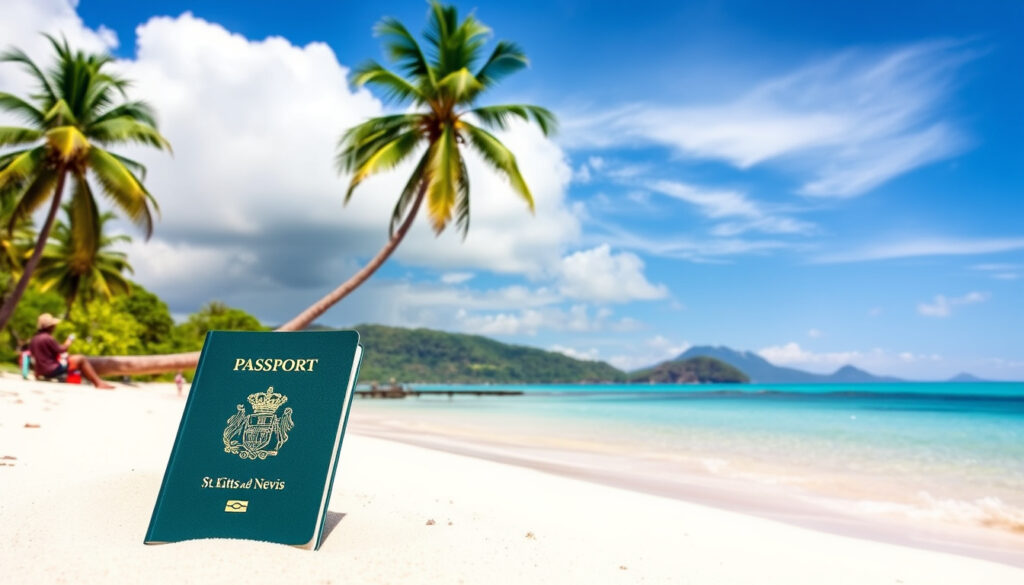
St Kitts Nevis – Country Facts, Passport Rank and Travel Guide
St Kitts and Nevis, officially the Federation of Saint Christopher and Nevis, is a twin-island nation in the Caribbean Sea. It is the smallest sovereign state in the Western Hemisphere by both area and population, yet it punches well above its weight in tourism, citizenship-by-investment, and passport mobility. This guide covers everything from geography and climate to visa-free travel and practical tips for 2025.
The country consists of two volcanic islands separated by a narrow channel known as The Narrows, just 3 km wide. Saint Kitts (Saint Christopher) is the larger island; Nevis is smaller and quieter. Together they form a federation that has been independent since 1983, but their history stretches back to pre-Columbian times and includes centuries of European colonial struggle.
Understanding St Kitts and Nevis means looking at its geography, its modern economy driven by tourism and investment, and a passport that ranks among the most powerful in the Caribbean. This article provides a fact-based overview for travellers, investors, and anyone curious about this unique nation.
What Is Saint Kitts and Nevis?
St Kitts and Nevis is a sovereign country in the West Indies, part of the Leeward Islands chain. Its official name is the Federation of Saint Christopher and Nevis. The capital is Basseterre, located on Saint Kitts. English is the official language, and the currency is the Eastern Caribbean Dollar (XCD).
Federation of Saint Christopher and Nevis
Basseterre (on Saint Kitts)
261 km² (101 sq mi)
~48,000 (2024 est.)
Key facts about St Kitts and Nevis
- Smallest sovereign state in the Western Hemisphere by area and population.
- Dual-island federation; tourism and offshore finance are key economy drivers.
- Weather is tropical with wet/dry seasons; best visited December to May to avoid hurricane season.
- Passport ranks among the top 30 globally (Henley Index ~27th) with visa-free access to about 160 countries.
- Currency is the Eastern Caribbean Dollar (XCD) pegged to the US dollar.
- Direct flights available from major US and UK hubs.
| Category | Fact |
|---|---|
| Full Name | Federation of Saint Christopher and Nevis |
| Capital | Basseterre (Saint Kitts) |
| Largest City | Basseterre |
| Official Language | English |
| Currency | Eastern Caribbean Dollar (XCD) |
| Time Zone | UTC-4 (Atlantic Standard Time) |
| Driving Side | Left |
| Calling Code | +1-869 |
| ISO Code | KN |
What Is the Weather, Currency, and Travel Info for St Kitts and Nevis?
Travellers to St Kitts and Nevis want to know what to expect from the climate, how to pay, and how to get there. The islands have a stable tropical climate that rarely dips below 20°C. The best time to visit is between December and April, when the weather is driest and sunniest. Hurricane season runs from June to November, with September and October posing the highest risk.
Currency and payments
The Eastern Caribbean Dollar (XCD) is the official currency, fixed at 2.70 XCD to 1 USD. US dollars are widely accepted in tourist areas, but change is often given in local currency. Credit cards are accepted at most hotels and restaurants on both islands.
Flights and getting around
Robert L. Bradshaw International Airport on Saint Kitts receives direct flights from Miami (about 3 hours), New York, and London. Charter flights also land at Vance W. Amory International Airport on Nevis. A regular ferry service connects Basseterre and Charlestown, making inter-island travel easy. Taxis and rental cars are available, but driving is on the left.
Most visitors from the US, UK, Canada, and the Schengen area do not need a tourist visa for stays up to 90 days. However, all passengers must complete an Electronic Travel Authorization (eTA) before arrival. As of 1 September 2025, the eTA fee rises to $17.00. Always check the latest entry requirements with official sources.
Safety for tourists
St Kitts and Nevis is generally safe for visitors. Petty theft occasionally occurs on St Kitts, particularly at Conaree Beach, but violent crime is rare. Nevis is considered even quieter and safer. As in any destination, travellers should lock valuables and avoid isolated areas after dark.
What Is the Saint Kitts and Nevis Passport Ranking?
The Saint Kitts and Nevis passport is one of the strongest in the Caribbean. Holders can travel visa-free or visa-on-arrival to 156 countries, including Schengen states, the United Kingdom, Singapore, and Hong Kong. This mobility is a major draw of the country’s citizenship-by-investment program.
The Henley Passport Index currently ranks the St Kitts and Nevis passport around 27th globally. While visa‑free agreements are generally stable, they can change with little notice. Always verify your destination’s entry rules using a reputable passport index or the ministry of foreign affairs before travel.
Citizenship by Investment (CBI)
Foreign nationals can obtain citizenship – and therefore a passport – through a contribution to the Sustainable Growth Fund or by investing in government-approved real estate. The program, launched in 1984, is one of the oldest and most established in the world. Successful applicants gain visa-free access to the 156 countries listed above.
Entry requirements for visitors to St Kitts and Nevis
Tourists and business visitors do not require a visa for stays of up to 90 days, provided they hold a passport valid for at least six months from the date of entry and have an onward ticket and proof of accommodation. A mandatory Electronic Travel Authorization (eTA) must be completed online before travel. Student visas are required for longer stays.
Historical Timeline of St Kitts and Nevis
- 1493: Christopher Columbus sights the islands during his second voyage.
- 1623: First English settlement established – St Kitts becomes the first English colony in the Caribbean.
- 1783: Treaty of Paris confirms British control after years of British-French conflict.
- 1967: St Kitts and Nevis becomes an associated state of the UK with internal self-government.
- 1983: Independence from the United Kingdom on 19 September.
- 1998: Referendum on Nevis secession fails to reach the required two-thirds majority.
- 2023: 40th independence anniversary celebrated.
What Is Certain and What Can Change?
| Established facts | Information that remains uncertain or changeable |
|---|---|
| St Kitts and Nevis is an independent sovereign nation. | Passport visa‑free agreements can be updated – always verify with official sources. |
| Official language is English. | Weather forecasts beyond 7 days are approximate. |
| Currency is the Eastern Caribbean Dollar (XCD). | Flight routes and schedules vary by season. |
| Capital is Basseterre. | Election dates and political landscape may shift. |
How Does St Kitts and Nevis Compare to Other Caribbean Destinations?
St Kitts and Nevis shares many traits with Antigua and Barbuda – similar size, dual-island structure, and a strong focus on tourism. However, St Kitts and Nevis is unique for its rapid citizenship-by-investment program and its quiet, unspoiled character. About 90% of the country remains natural, with volcanic peaks, rainforest, and coral reefs. Nevis, in particular, offers a slower pace, known as the birthplace of Alexander Hamilton. Compared to St Vincent and the Grenadines, which is larger and less tourism‑developed, St Kitts and Nevis has more established infrastructure and direct flight connections.
Where to Find Reliable Information
The following sources provide authoritative data on St Kitts and Nevis. For geography, demographics, and history, Wikipedia offers a comprehensive overview. Official statistics on population and area come from the St. Kitts and Nevis Bureau of Statistics. Passport rankings and visa‑free scores are tracked by the Passport Index. For travel context and holiday ideas, guides from Kuoni and Tropical Sky are useful.
“St Kitts and Nevis is a twin-island Caribbean nation … known for its volcanic geography, sugar-historical colonial past, and a citizenship-by-investment program.”
– IMIN Caribbean
“The islands are distinct emerald specks in the Caribbean, easily identifiable by their twin volcanic silhouettes separated by the Narrows.”
– Erika’s Travels
What’s Next for St Kitts and Nevis?
St Kitts and Nevis continues to evolve as a stable, attractive destination for tourists and investors. If you are planning a trip, check current visa-free destinations for passport holders, compare flight prices, and explore the citizenship-by-investment program in more detail. For history enthusiasts, the 1998 Nevis secession debate and the country’s political future remain topics of interest. You may also enjoy reading about Greek Gods – Names, Family Tree, Powers And Roman Equivalents or Mona Lisa – Facts, History, Theft, and Mystery Explained for a change of pace.
Frequently Asked Questions
Where is St Kitts Nevis on the map?
St Kitts and Nevis is located in the Caribbean Sea, about 2,000 km southeast of Miami, part of the Leeward Islands chain. Basseterre (on St Kitts) is at 17.3° N, 62.7° W.
What is the best time to visit St Kitts and Nevis?
December to April offers the warmest, driest weather. May and November are shoulder months with fewer crowds. Hurricane season runs June to November, with peak risk in September and October.
Do I need a visa for St Kitts and Nevis?
Most nationals (US, UK, Canada, Schengen) do not need a tourist visa for stays up to 90 days. All passengers must complete an Electronic Travel Authorization (eTA) before travel.
How strong is the St Kitts and Nevis passport?
The passport offers visa-free access to 156 countries, including Schengen states, the UK, Singapore, and Hong Kong. It ranks around 27th globally.
What currency is used in St Kitts and Nevis?
The Eastern Caribbean Dollar (XCD) is the official currency. US dollars are widely accepted. The exchange rate is fixed at 2.70 XCD to 1 USD.
Is St Kitts and Nevis safe for tourists?
Generally yes. Petty theft can occur on St Kitts (e.g., Conaree Beach), but violent crime is rare. Nevis is considered very safe.
How do I get to St Kitts and Nevis?
Robert L. Bradshaw International Airport on St Kitts receives direct flights from Miami, New York, and London. A ferry connects St Kitts and Nevis.
What is the citizenship-by-investment program?
Foreign investors can obtain citizenship through a contribution to the Sustainable Growth Fund or by purchasing government-approved real estate, gaining a passport with visa-free travel to 156 countries.
How big is St Kitts and Nevis?
The total area is 261 km² (101 square miles). It is the smallest independent state in the Western Hemisphere.
What is the capital of St Kitts and Nevis?
The capital is Basseterre, located on the island of Saint Kitts. It is home to about half of the country’s population.
More related posts
 Alexandra Daddario – Age, Husband, Movies & TV Shows (2025 Bio)
 Ice T – Biography, Net Worth, Movies, Band and Family 2025
 Robin Gunningham – The Man Alleged to Be Banksy
 Lee Miller – Biography, Photography, and WWII Legacy Explained
 Christopher Reeve – Superman Actor, Accident, and Legacy
 Timothée Chalamet and Kylie Jenner – Status and Latest Updates
 Rashid Khan – Profile, Wife Rumors, Net Worth and Career Facts
 What Does ADHD Stand For – Complete Guide and Symptoms
